

New System Developed to Combine Heat Pump Heating with Humidity Control

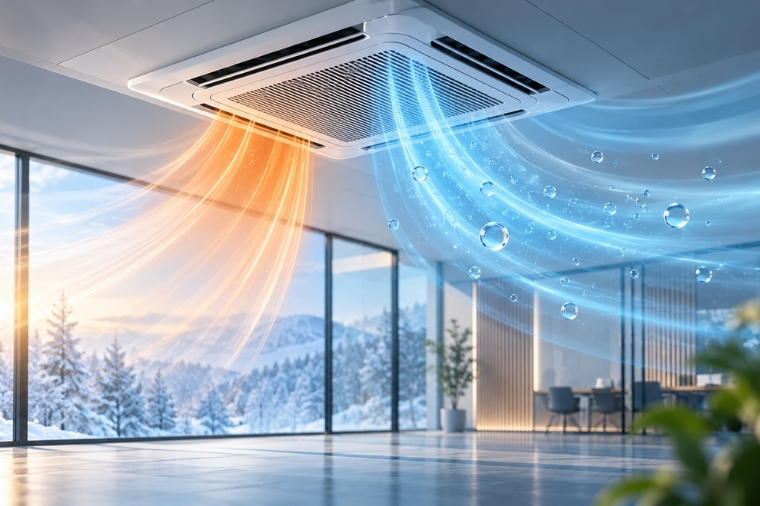
A new study published in Applied Thermal Engineering has developed a solution to address low indoor humidity in spaces heated by heat pumps during winter. A hollow-fiber membrane humidification system integrated into the indoor unit of a ceiling cassette electric heat pump reached the target humidity level approximately 40% faster than a conventional portable ultrasonic humidifier in field tests. The research demonstrates that humidity control can be integrated directly into a split-type heat pump system.
Heating indoor spaces during winter affects not only thermal comfort but also humidity balance. While split-type heat pumps can control temperature by circulating indoor air, their system configuration does not directly control air humidity. Under dry winter conditions, this can cause indoor humidity to fall below the comfort range.
A new study conducted by Jeong-min Oh, Ju-Hyun Lee, Seheon Kim and Jae-Weon Jeong explores a solution to this issue by integrating humidification directly into the indoor unit of a heat pump.
In their study titled “Applicability of a hollow-fiber membrane humidifier integrated into an electric heat pump for heating of the office space,” the researchers integrated a Hollow-Fiber Membrane (HFM) humidifier into a ceiling cassette electric heat pump.
The system was first evaluated through numerical simulations and subsequently through field tests under real operating conditions.
Humidification Function Integrated into the Heat Pump Indoor Unit
The reference system used in the study was a ceiling cassette electric heat pump, a type commonly used in small and medium-sized offices.
In a conventional system, indoor air is drawn through the central inlet, passes through a filter and heat exchanger, and is then supplied back into the room.
The researchers integrated a hollow-fiber membrane humidifier into this configuration. Instead of using a separate portable humidifier, the aim was to make humidification part of the heat pump’s air circulation system.
The performance of the proposed system was compared with that of a portable ultrasonic humidifier operating in the same heating environment.
No Direct Contact Between Water and Air
One of the notable aspects of the technology is the way moisture is transferred to the air.
The hollow-fiber membrane used in the study has a composite structure consisting of a hydrophilic polyvinyl alcohol (PVA) dense layer and a porous polyethersulfone (PES) support layer.
Water vapor is transported through the membrane as a result of the partial pressure difference between the water and air. Moisture first enters the hydrophilic PVA layer and then diffuses through the polymer at the molecular level before being transferred from the opposite surface into the air.
With this approach, rather than spraying water directly into the airflow, water vapor is transferred through the membrane.
Another important advantage of the hollow-fiber structure is its ability to provide a large membrane surface area within a small volume. This characteristic is significant for enabling more compact integration of the technology into HVAC equipment.
Target Humidity Level Reached in 11 Minutes in Simulation
In the first stage of the research, the proposed system was numerically modeled.
The lower limit of the comfort humidity range in the study was defined as a humidity ratio of 6.6 g/kg.
According to the simulation results, the HFM system integrated into the heat pump reached this level in 11 minutes.
This was approximately 63% shorter than the time required by the ultrasonic humidifier used for comparison.
However, the researchers did not rely solely on the simulation results. Because real-world conditions such as uneven air distribution and air leakage are difficult to represent fully in a numerical model, the system was also tested under field conditions.
Approximately 40% Faster in Field Tests
A similar trend was observed under real-world test conditions.
In two repeated field experiments, the membrane-based system reached the target humidity ratio of 6.6 g/kg in 22 and 34 minutes, respectively.
By comparison, the reference system required 46 and 48 minutes to reach the same level.
According to the researchers’ assessment, the proposed system reached the target humidity level approximately 40% faster under field conditions.
An important distinction should be made here: the 40% figure does not represent energy savings or an increase in the heat pump’s COP.
Instead, it represents the improvement in the time required to reach the target indoor humidity level during the field tests.
It would therefore be incorrect to interpret the result as meaning that “heat pump efficiency increased by 40%.”
Humidification Naturally Slows as Indoor Humidity Increases
One of the study’s interesting findings from an HVAC control perspective is that the humidification rate changes according to indoor conditions.
When the indoor environment is initially dry, the difference in water vapor partial pressure between the water and air is greater, resulting in faster moisture transfer through the membrane.
As indoor humidity increases, however, this difference decreases and the humidification rate naturally slows.
According to the researchers, this characteristic allows the system to raise humidity levels rapidly under initially dry conditions and subsequently helps maintain conditions within the comfort range.
In other words, the system’s moisture transfer mechanism changes naturally depending on the existing indoor humidity level.
Addressing the Humidity Challenge of Heat Pump Heating in Winter
In split-type heat pumps, indoor air is continuously recirculated. However, while conventional systems control temperature, they do not include a mechanism that actively adds moisture to the air.
For this reason, the researchers identified indoor humidity falling below the comfort range, particularly during winter heating periods, as the fundamental problem addressed by the study.
Today, this issue can often be addressed using standalone humidifiers. What distinguishes the new study is its aim to transform humidity control from a function performed by a separate device into one integrated into the heat pump’s indoor unit.
This approach is noteworthy for the future development of more integrated systems in which temperature and humidity can be controlled through the same HVAC equipment.
Taking Previous Membrane Research One Step Further
The use of hollow-fiber membranes for humidification in HVAC systems is not an entirely new concept.
Previous studies by the same research group investigated water-to-air cross-flow hollow-fiber membrane modules and explored the technology’s potential for clean and energy-efficient humidification.
One of the distinguishing features of the new research is that the membrane humidifier was integrated directly into a split-type electric heat pump and tested under real field conditions.
The researchers note that most previous studies provided limited investigation of humidification behavior under real-world field conditions and limited comparisons with other humidification methods.
Could Pave the Way for Integrated Humidity Control in HVAC Systems
The study results indicate that integrating hollow-fiber membrane humidification technology into split-type heat pumps is technically feasible.
However, the study does not yet demonstrate that the technology will deliver the same performance across all building types or under different climatic conditions.
The research was conducted using a specific ceiling cassette electric heat pump, an office environment and defined operating conditions. Therefore, the results should not be directly generalized to heat pumps of different capacities, residential applications or different climate zones.
Nevertheless, the similar trends observed in both the numerical model and field tests suggest that membrane-based humidification is a technology worth further investigation for integrated humidity control in heat pump-based HVAC systems.
Scientific Source: The study titled “Applicability of a hollow-fiber membrane humidifier integrated into an electric heat pump for heating of the office space,” by Jeong-min Oh, Ju-Hyun Lee, Seheon Kim and Jae-Weon Jeong, was published in Applied Thermal Engineering, Volume 304, Part 3, Article 132759. DOI: 10.1016/j.applthermaleng.2026.132759.