
New Research: Ventilation Is as Critical as Insulation in Building Renovation

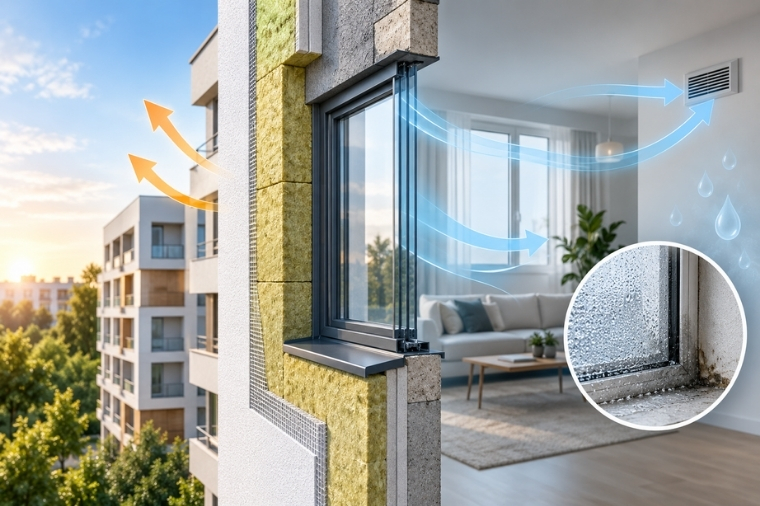
Building renovations aimed at improving energy efficiency can enhance the thermal performance of the building envelope while creating an unexpected challenge: insufficient ventilation and moisture accumulation. New research published in Energy and Buildings on September 15, 2026, shows that in residential buildings renovated with external insulation and airtight windows, the risk of surface condensation and moisture-related building damage may persist if ventilation is not addressed as part of the renovation process.
External wall insulation, window replacement, and improvements in building airtightness are among the most widely used measures to reduce energy consumption in buildings. However, increasing the airtightness of a building can also significantly reduce the air exchange that previously occurred through uncontrolled air leakage.
A new study titled “Impact of thermal retrofitting and reduced ventilation on moisture accumulation and durability in large-panel residential buildings,” conducted by Aldona Skotnicka-Siepsiak, Piotr Knyziak, Carles Serrat, and Janusz R. Krentowski, focuses specifically on this relationship. The research examines moisture and ventilation problems that may arise following energy renovation in large-panel residential buildings, particularly those widely constructed across Central and Eastern Europe during the 1970s and 1980s.
Thermal Insulation Can Improve While Natural Air Exchange Declines
According to the researchers, natural ventilation systems in these older buildings, typically driven by the stack effect, were originally designed in conditions where air leakage through the building envelope and windows effectively contributed to overall air exchange.
In modern renovation projects, ETICS-type thermal insulation systems are applied to external façades, while old and leaky wooden windows are replaced with modern windows offering significantly greater airtightness.
These measures improve the thermal performance of the building. At the same time, however, they can alter airflow patterns and reduce the effectiveness of natural ventilation.
In other words, sealing the air leaks responsible for heat loss can also make it more difficult to remove moisture generated indoors if an adequate ventilation solution is not provided.
16 Different Scenarios Analysed Using CFD
The study examined a representative apartment in a large-panel residential building and developed a total of 16 different scenarios.
The researchers evaluated four different historical and current thermal insulation standards in combination with four different air change rates. The investigated air change rates ranged from 0.5 to 3.0 h⁻¹.
Computational Fluid Dynamics (CFD) analyses based on the Finite Volume Method were used to determine temperature distribution, airflow patterns, and water vapour concentration.
It is therefore important to note that the findings were derived from numerical analyses based on a specific residential building type and defined operating conditions, rather than from long-term field measurements conducted in actual buildings.
Insulation Increased Surface Temperatures but Did Not Solve the Moisture Problem on Its Own
The results showed that thermal renovation increased interior surface temperatures. From a building physics perspective, this is a positive outcome because warmer internal surfaces generally help reduce the risk of condensation under normal conditions.
However, one of the study's key findings is that insulation alone is not sufficient.
In scenarios with inadequate air exchange, significant moisture accumulation occurred indoors. This was particularly evident in bathrooms and areas with poor ventilation.
As a result, a better-insulated and more airtight building envelope does not necessarily guarantee better indoor conditions in every situation. If water vapour generated indoors cannot be adequately removed, high relative humidity and surface condensation may occur.
An Air Change Rate of 1.0 h⁻¹ Was Insufficient Under Some Conditions
One of the most notable findings concerns the air change rate.
Under the conditions examined in the study, even an air change rate of 1.0 h⁻¹ was found to be potentially insufficient to prevent surface condensation.
The model indicated that the air change rate needed to be at least doubled to effectively reduce moisture-related risks.
However, this finding should not be interpreted as meaning that “all residential buildings require an air change rate of 2.0 h⁻¹.” The results apply specifically to the building, climate, occupancy, and moisture-generation conditions examined in the study.
Required ventilation rates can vary depending on numerous factors, including building use, occupancy levels, indoor moisture loads, climate, ventilation system type, and national standards.
The broader conclusion of the research is that focusing solely on the thermal performance of the building envelope during energy renovation may not be sufficient.
Moisture Is Not Only an Indoor Air Quality Issue
High indoor humidity is often considered primarily in terms of occupant comfort or indoor air quality. The new research also highlights the structural dimension of the problem.
Increased moisture and surface condensation associated with inadequate ventilation can accelerate the deterioration of building materials over time. The researchers indicate that deterioration processes such as reinforcement corrosion in sensitive areas of the structure may be affected by high-moisture conditions.
Ventilation design therefore emerges not only as an HVAC issue related to supplying fresh air to occupants, but also as a factor associated with the long-term durability of the building.
A More Airtight Building Should Not Mean Less Ventilation
One of the study's important messages for the HVAC sector concerns the relationship between airtightness and controlled ventilation.
In older buildings, uncontrolled air leakage through windows and the building envelope contributes to energy losses. Reducing these leaks through energy renovation is an appropriate strategy, but eliminating uncontrolled air infiltration does not eliminate the need for controlled ventilation.
On the contrary, as buildings become more airtight, the way ventilation is provided becomes increasingly important for indoor air quality and moisture control.
This is particularly critical when renovating older residential buildings that rely on natural ventilation. Replacing windows and adding external insulation while leaving the existing ventilation infrastructure unchanged can alter the airflow balance that existed before renovation.
Energy Renovation Requires an Integrated Approach
The researchers therefore emphasise that energy renovation should follow an integrated design approach in which thermal insulation, airtightness, and ventilation are considered together.
The objective should not be limited to reducing heating and cooling demand. Energy efficiency improvements should also maintain indoor air quality, moisture control, and structural durability.
This approach also points to an important shift for the HVAC sector. As the energy performance of the existing building stock improves, ventilation systems should no longer be regarded as a secondary element of renovation projects, but as a fundamental component that needs to be considered alongside building-envelope improvements.
Research: Aldona Skotnicka-Siepsiak, Piotr Knyziak, Carles Serrat, Janusz R. Krentowski, “Impact of thermal retrofitting and reduced ventilation on moisture accumulation and durability in large-panel residential buildings,” Energy and Buildings, Volume 367, Article 117796, September 15, 2026.