


New Research Area in the HVAC Industry: Human–HVAC Interaction

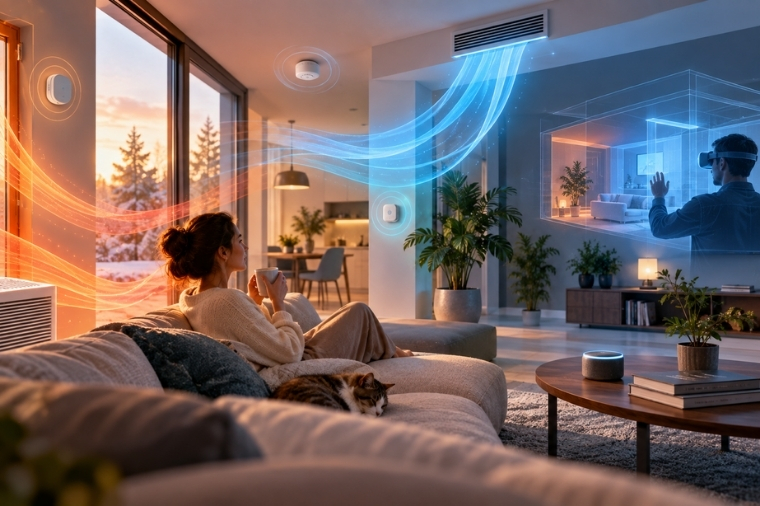
Evaluating HVAC systems in smart homes solely in terms of energy consumption and temperature control may no longer be sufficient. A new research approach aims to investigate how users interact with heating systems, considering thermal comfort, indoor environmental quality, energy costs and sustainability together. Known as “Human–HVAC Interaction,” this approach plans to employ various methods, ranging from real-world living laboratories and virtual reality to environmental sensors.
With the increasing adoption of smart thermostats, sensors, building automation and connected HVAC equipment, residential heating systems are becoming increasingly digitalized. However, as HVAC systems become technically smarter, there is also a growing need to better understand how users interact with these systems.
A study titled “Designing for Healthy, Affordable, and Sustainable Human-HVAC Interactions for Heating in Smart Homes,” prepared by Delong Korus-Du, addresses this issue by introducing Human–HVAC Interaction as a research area. The study focuses specifically on heating in smart homes.
The Human Factor Gains Importance in HVAC Control
The research approach is based on the idea that HVAC systems should do more than simply maintain a specific indoor temperature. It aims to evaluate factors such as users' perceptions of thermal comfort, daily heating habits, indoor environmental quality and energy costs alongside system design and control strategies.
For this reason, the study considers thermal comfort and indoor environmental quality (IEQ) together. The researcher aims to investigate how people perceive smart HVAC systems, how they interact with these systems and how they respond to changing indoor environmental conditions.
This approach is particularly important for the future development of user-centered HVAC control algorithms. While conventional control systems are generally based on parameters such as temperature, humidity or predefined operating schedules, the Human–HVAC Interaction approach also considers user behavior an essential component of the system.
HVAC User Behavior to Be Studied in Real-Life Environments
One of the notable aspects of the research involves long-term living lab studies.
These studies will examine how people use heating systems in their daily lives, their thermal comfort expectations and their relationship with indoor environmental quality. The research also considers that different user groups may respond differently to the same indoor environmental conditions.
As a result, future smart HVAC systems may adopt more flexible control strategies that take individual users and operating conditions into account, rather than relying on a one-size-fits-all approach to comfort.
Virtual Reality Enters HVAC Research
One of the most notable aspects of the study is the planned use of virtual reality (VR) technology in HVAC research.
The research proposes developing a VR-based smart home model to evaluate different heating and indoor environmental quality scenarios within a virtual living laboratory.
This method aims to enable different HVAC scenarios to be tested in a virtual environment before being implemented in a physical residence, while examining how users interact with these systems.
However, the study also highlights an important limitation of VR technology. Although virtual reality can successfully simulate visual and auditory environments, representing indoor environmental conditions directly perceived by the human body, such as temperature, humidity and air movement, is more challenging. The research program also plans to evaluate these limitations separately.
Distributed Environmental Sensors to Be Used
In the subsequent stages of the research, findings obtained from the VR environment are expected to be transferred to physical and digital prototypes.
Within this framework, distributed environmental sensing systems, digital fabrication methods and different user interfaces are planned to be used together. This will make it possible to evaluate user behavior alongside data collected from sensors measuring temperature and other indoor environmental parameters.
This approach could pave the way for greater consideration of user interaction in the development of various HVAC technologies, ranging from smart thermostats to residential building automation systems.
A New Question for Smart HVAC Systems: How Well Does the System Understand Its Users?
Digitalization in HVAC technologies has so far largely focused on energy efficiency, automatic control, remote access and system optimization. The Human–HVAC Interaction approach introduces another dimension to this discussion: Regardless of how technically advanced an HVAC system may be, to what extent can it understand users' actual comfort needs and daily behavior?
The new research program does not provide a definitive answer to this question. Instead, it aims to establish a new research framework by combining multidisciplinary literature reviews, real-world living laboratories, co-design studies, VR-based prototyping and physical system development.
The study was submitted to arXiv on September 7, 2026, and is included in the proceedings of the Mensch und Computer 2026 conference.
Source: Delong Korus-Du, Designing for Healthy, Affordable, and Sustainable Human-HVAC Interactions for Heating in Smart Homes, 2026.