

New Copper-Foam Evaporator Developed for Data Center Cooling

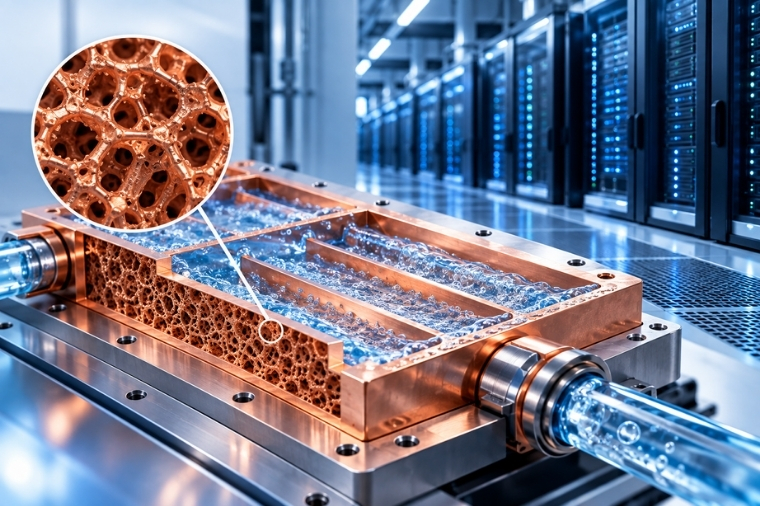
A research team involving scientists from Shandong University and RMIT University has developed a microstructured superhydrophobic copper-foam evaporator designed to cool electronic components operating under extreme heat flux conditions. In an experimental study published in Applied Thermal Engineering, the researchers achieved a critical heat flux (CHF) of 414.5 W/cm² and a heat transfer coefficient (HTC) of 77.5 kW/(m²·K) simultaneously using an evaporator combining 500 PPI copper foam with mini-channels. The study identifies potential applications for the technology in the thermal management of data centers with high cooling demands.
The rapid expansion of artificial intelligence and high-performance computing applications is increasing processor power densities and associated thermal loads in data centers. This development creates a growing need for efficient heat removal from electronic components, particularly in multi-node edge data centers.
Conducted by Junteng Cao, Yuankun Zhang, Huajie Li, Xianbo Nian, Chaoyi Zhang, Keng-Te Lin, Han Lin, Chunsheng Guo, and Baohua Jia, the research focuses on improving the heat transfer capacity of two-phase cooling systems used in high-heat-flux electronics cooling.
The study was published in Volume 304 of Applied Thermal Engineering under Article 132755.
Copper Foam and Mini-Channels Integrated into a Single Evaporator
The researchers designed a new evaporator for a mechanically pumped two-phase loop (MPTL), integrating microstructured superhydrophobic copper foam with a pore density of 500 pores per inch (500 PPI) and mini-channels.
According to the study, the high pore density of the copper foam increases the available heat transfer surface area and provides additional nucleation sites for boiling.
The mini-channels and superhydrophobic surface help regulate vapor removal and liquid replenishment at the heat transfer surface. Vapor-liquid separation within the evaporator results from the combined effects of surface wettability, pore density, and channel confinement.
Deionized water was used as the working fluid during the experiments.
The researchers compared copper foams with different pore densities and surface wettability characteristics. Bubble nucleation, growth, and departure behavior were examined using high-speed imaging techniques to better understand the boiling and heat transfer mechanisms.
Critical Heat Flux Reaches 414.5 W/cm²
One of the main findings of the research was the ability to achieve high critical heat flux and heat transfer coefficient values simultaneously.
The configuration incorporating 500 PPI superhydrophobic copper foam achieved a critical heat flux of 414.5 W/cm² and a heat transfer coefficient of 77.5 kW/(m²·K) under the same operating conditions.
These values were obtained at a coolant mass flux of 66 kg/(m²·s).
The study evaluated superhydrophobic copper foams with pore densities of 100, 500, and 1000 PPI.
The measured critical heat flux values were 380.2 W/cm², 414.5 W/cm², and 289.3 W/cm², respectively.
The corresponding heat transfer coefficients were 71.7, 77.5, and 46.8 kW/(m²·K).
The results demonstrated that the 500 PPI configuration delivered the highest critical heat flux and heat transfer coefficient among the tested configurations under the experimental conditions.
Vapor-Liquid Separation Analyzed Using High-Speed Imaging
The researchers used high-speed imaging to investigate the boiling process occurring inside the evaporator.
The findings showed that pore density, surface wettability, and mini-channel confinement collectively influenced bubble behavior and vapor-liquid separation.
In the 500 PPI configuration, the porous structure provided sufficient surface area for bubble nucleation, while the mini-channels facilitated vapor removal from the heated surface.
This arrangement helped limit vapor accumulation and supported the replenishment of liquid at the heat transfer surface, contributing to more effective heat removal.
The experiments also demonstrated that increasing the pore density to 1000 PPI did not result in further performance improvements under the same operating conditions.
The researchers attributed this behavior to the increased flow resistance associated with smaller characteristic pore sizes, which can restrict vapor evacuation from the porous structure.
Critical Heat Flux and Heat Transfer Coefficient Evaluated Together
In two-phase electronics cooling systems, critical heat flux represents the upper limit of heat flux that can be removed through stable boiling.
Exceeding this limit can lead to the formation of a vapor layer over the heated surface, potentially causing a rapid deterioration in heat transfer performance.
The heat transfer coefficient, meanwhile, indicates the effectiveness of heat transfer between the heated surface and the coolant.
According to the researchers, previous two-phase evaporator designs have separately achieved critical heat flux values exceeding 300 W/cm² or heat transfer coefficients above 75 kW/(m²·K).
However, maintaining both parameters at high levels simultaneously has remained a technical challenge.
The newly developed evaporator addresses this challenge by combining a microstructured superhydrophobic copper-foam surface with mini-channels to achieve high critical heat flux and heat transfer coefficient values under the investigated operating conditions.
System-Level Studies Planned for Data Center Cooling Applications
In the conclusion of the paper, the researchers indicate that the developed evaporator could be considered for high-heat-flux thermal management applications, particularly in data centers with demanding cooling requirements.
The technology may offer potential benefits for managing the increasing thermal loads associated with artificial intelligence processors, high-performance computing infrastructure, and high-density electronic systems.
However, the study emphasizes that the technology has currently been validated experimentally at the evaporator level.
Further research will focus on system-level integration and long-term operational validation under realistic data center conditions.
These future investigations will be important for determining the practical applicability of the technology in data center cooling systems.
References: Cao, J.; Zhang, Y.; Li, H.; Nian, X.; Zhang, C.; Lin, K.-T.; Lin, H.; Guo, C.; Jia, B. An integrated microstructural superhydrophobic copper-foam evaporator for extreme heat flux cooling. Applied Thermal Engineering, Vol. 304, Part 2, Article 132755, 2026. DOI: 10.1016/j.applthermaleng.2026.132755.