AI Reshapes HVAC Applications at TTMD International HVAC+R Technology Symposium

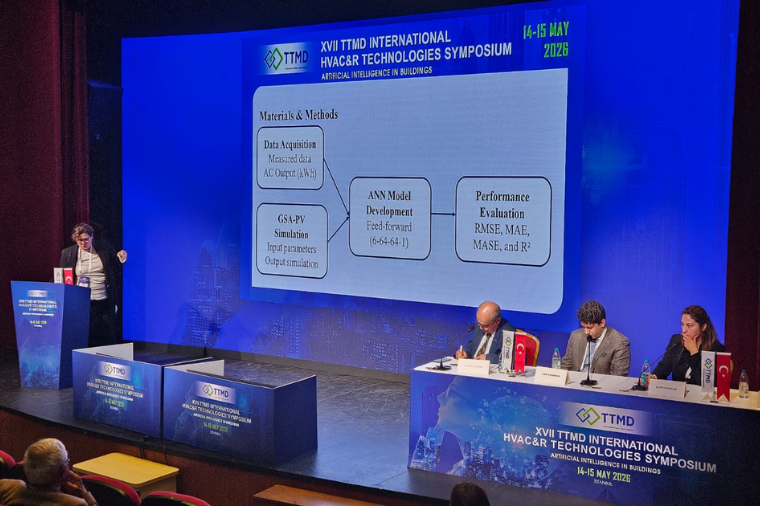
On the first day of the symposium (May 14, 2026), organized under the main theme “Artificial Intelligence in HVAC Applications,” academics, industry professionals, researchers, and young engineers came together. During the hybrid-format event, it was emphasized that AI-supported HVAC&R applications are no longer only a future research topic, but have become a powerful tool transforming today’s engineering practices.
Following the opening speeches, the “Chat with AI” session provided a general framework on the impact of artificial intelligence on engineering processes.
The opening technical session focused on current topics such as machine learning, AI applications in HVAC systems, and BIM–digital twin technologies.
Dr. Burcu Koçak’s presentation titled “Artificial Intelligence in Thermal Energy Storage Building Applications” addressed AI-supported management of thermal energy storage systems in buildings. Approaches developed particularly in load forecasting, energy demand management, and operational optimization attracted significant attention.
Dr. Tuğba Gürler presented “Machine Learning Based Solar PV Forecasting for Sustainable Buildings,” which evaluated the use of machine learning methods for solar energy production forecasting in sustainable building applications. The importance of forecasting accuracy for system reliability in renewable energy integration was highlighted.
Presentations focusing on industrial applications also emphasized digitalization and data-driven system management. In his presentation “Digital Hydronic Balancing in Heat Interface Units,” Can Kodaman demonstrated the impact of digital balancing methods on energy performance and operational efficiency in hydronic systems.
 Particular attention was drawn to the presentation “AI in Building HVAC System” by Prof. Dr. Livio Mazzarella of Politecnico di Milano, a leading academic in the HVAC sector and an active member and coordinator within REHVA (Federation of European Heating, Ventilation and Air Conditioning Associations). The presentation evaluated the effects of AI applications in building HVAC systems on energy management, control strategies, and occupant comfort. It was emphasized that data collection, forecasting, and optimization processes are increasingly taking on a more central role, especially in large-scale building systems.
The afternoon technical sessions highlighted energy transition and sustainable building technologies. Prof. Dr. Halime Paksoy’s presentation titled “GREENOLIVE Project for Decarbonization of Industry with Power to Heat Concept” addressed heat-based energy transformation strategies in industrial decarbonization processes. It was stated that electrification and thermal energy integration will play a critical role in future energy systems.
The second technical session of the day saw a notable concentration of studies focused on data center thermal management. In particular, detailed discussions explored how artificial intelligence, physics-based modeling, and digital twin approaches can be utilized in high-energy-density systems such as data centers.
 Meriç Sapçı’s presentation titled “Performance-Based Hydronic System Design with Digital Twin Application in Water Loop Heat Pump Systems” evaluated the use of digital twin applications for performance analysis in water-loop heat pump systems. It was emphasized that these systems can now become continuously monitored and optimized not only during the design phase but also throughout operational processes.
The final part of the day featured two presentations delivered by undergraduate students from the Faculty of Mechanical Engineering at Istanbul Technical University, drawing attention as examples of how young researchers are approaching contemporary engineering challenges.
In his presentation “Artificial Intelligence for Data Center Thermal Management: Methods, Integration, and Practical Guidelines,” Ömer Yiğit Türkarslan addressed AI-supported thermal management methods in data centers, the integration of data-driven approaches with CFD-based analyses, and practical implementation guidelines. It was highlighted that data centers have become one of the most critical focus areas in HVAC&R due to their increasing energy intensity.
Türkarslan also presented another study conducted together with fellow ITU student Koray Ömercan Saçlı titled “Physics-Constrained Deep Learning for Sparse Data Reconstruction in Data Center Thermal Management.” The study focused on the use of Physics-Constrained Neural Network (PCNN) deep learning methods for sparse data challenges. The presentation emphasized that physics-based AI approaches could provide more reliable predictions in systems with limited sensor data. Both studies were supervised by Prof. Dr. Seyhan Uygur Onbaşıoğlu and received significant attention from participants.
Throughout the first day of the symposium, the presentations demonstrated that the HVAC&R industry is no longer being shaped solely from a mechanical systems perspective, but increasingly through the integration of data science, artificial intelligence, digital twins, and system integration approaches. The convergence of academic studies and industrial applications created an important knowledge-sharing environment for participants.