
AI Speeds Up Airflow Prediction in HVAC Heat Exchangers by 100,000 Times

Researchers at the University of Maryland have developed a new machine learning model capable of rapidly and accurately predicting uneven airflow in heat exchangers used in air-conditioning systems. According to the study, published in the International Journal of Refrigeration, the model can generate predictions approximately 100,000 times faster than conventional computational fluid dynamics (CFD) calculations, potentially providing engineers with a powerful tool for designing more efficient HVAC equipment.
Researchers at the Center for Environmental Energy Engineering (CEEE) at the University of Maryland have developed a machine learning-based approach to predict airflow maldistribution, a phenomenon that can significantly affect heat exchanger performance in air-conditioning systems.
The study, titled “Machine learning based prediction of airflow maldistribution in air-to-refrigerant heat exchangers,” was conducted by Brian O’Malley, James Tancabel and Vikrant Aute and published in Volume 189 of the International Journal of Refrigeration in September 2026.
Uneven Airflow Can Affect Heat Exchanger Performance
In air-to-refrigerant heat exchangers, uneven distribution of air across the heat exchanger surface can negatively affect system performance. Known as “airflow maldistribution,” this phenomenon represents an important design challenge, particularly in central air-conditioning systems featuring compact duct configurations.
The researchers note that previous studies have associated airflow maldistribution with cooling capacity losses of up to 65% in certain configurations. Oversizing heat exchangers to compensate for these losses can lead to greater material use, larger equipment dimensions and higher refrigerant charge requirements.
In the heat exchanger-level simulations conducted as part of the new study, heat transfer losses associated with airflow maldistribution ranged from 1% to 9% under the conditions investigated.
Machine Learning Is Approximately 100,000 Times Faster Than CFD
Traditional computational fluid dynamics (CFD) methods allow engineers to model airflow through heat exchangers in considerable detail. However, these calculations can take hours or even longer to complete, making it difficult to rapidly evaluate numerous geometries during the early stages of the design process.
To address this challenge, the University of Maryland team developed an artificial neural network-based machine learning model trained using data generated from porous-media CFD simulations.
One of the most significant findings of the research was the improvement in computational speed. The machine learning models achieved a speedup of approximately 10⁵ — or around 100,000 times — compared with full porous-media CFD calculations.
This dramatic reduction in computation time could allow engineers to evaluate significantly more heat exchanger configurations during the early stages of HVAC equipment design.
Tested Across Different Heat Exchanger Configurations
The research was not limited to a single heat exchanger geometry. The proposed approach was applied to A-type and U-type heat exchanger configurations commonly encountered in air-conditioning systems.
The machine learning models were trained using porous-media CFD simulations. According to the study, the models predicted volumetric airflow rates with errors of approximately 1.1% and 1.9%.
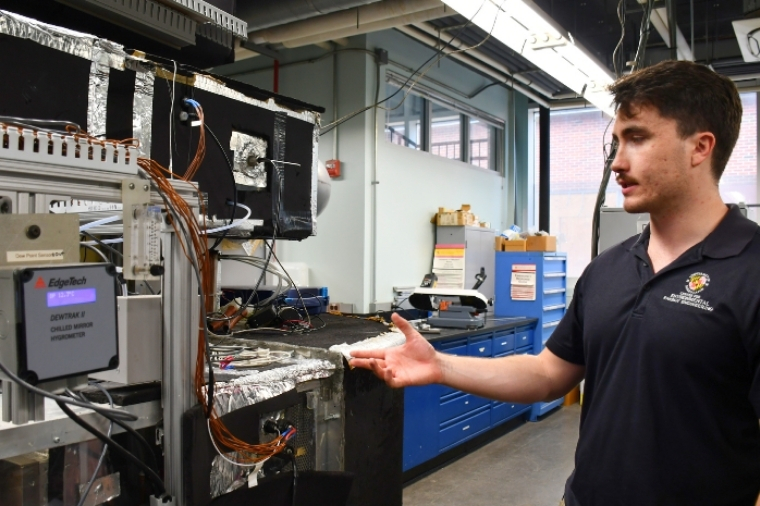
The researchers also validated the approach using three separate test datasets. Two were obtained from previously published studies, while the third came from experiments conducted on a prototype heat exchanger at the Daikin Energy Innovation Laboratory within the University of Maryland’s CEEE.
For the finless heat exchanger used in the experimental validation, the CFD model predicted 75% of the measured air velocities within ±0.15 m/s.
Could Help Reduce Heat Exchanger Oversizing
One of the most relevant aspects of the research for the HVAC industry is the potential integration of the proposed method directly into heat exchanger design workflows.
Faster prediction of airflow distribution during the design stage could enable engineers to compare different geometries and operating conditions in significantly less time. This could help reduce the need to oversize heat exchangers to compensate for potential capacity losses caused by uneven airflow.
In turn, the approach could contribute to the development of more compact HVAC equipment requiring less material and lower refrigerant charges.
However, these are design opportunities indicated by the research. The study does not demonstrate a specific energy-saving percentage achieved in commercial air-conditioning systems.
AI Could Become a New Tool in HVAC Design
The research demonstrates that the potential applications of artificial intelligence and machine learning in the HVAC industry may extend well beyond building automation and energy management.
Integrating machine learning directly into heat exchanger design, airflow analysis and performance prediction could significantly accelerate computationally intensive engineering processes.
The model developed by the University of Maryland team is particularly promising as an engineering tool for rapidly evaluating numerous design alternatives during the early stages of HVAC equipment development.
Scientific Source: Brian O’Malley, James Tancabel, Vikrant Aute (2026). “Machine learning based prediction of airflow maldistribution in air-to-refrigerant heat exchangers.” International Journal of Refrigeration, Volume 189, Article 107023. DOI: 10.1016/j.ijrefrig.2026.107023.
University of Maryland – Research Announcement
International Journal of Refrigeration – Scientific Paper