


Urban Heat Island Effect: The Silent Disaster Reshaping Cities, Health and Climate Justice

Author: M. Remzi ÇELİK
Mechanical Engineer
Introduction
The global climate crisis and climate justice are often perceived as distant and abstract issues. However, the Urban Heat Island (UHI) effect is a tangible urban challenge directly experienced every summer in metropolitan areas and large cities, threatening public health while deepening economic inequalities. Long regarded primarily as a technical phenomenon, it is increasingly recognized as an issue of health, governance, and social justice.
What Is the Urban Heat Island Effect?
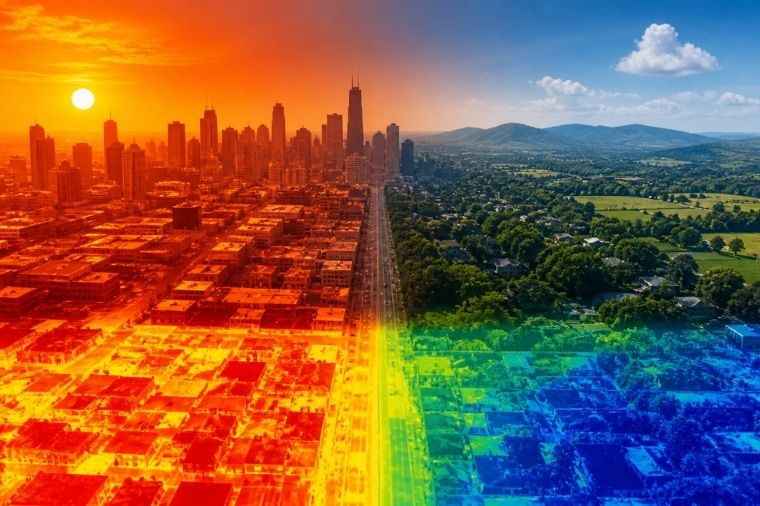
The Urban Heat Island effect refers to the phenomenon in which urban centers become significantly warmer than surrounding rural areas. This concept was first identified in the 19th century by the English scientist Luke Howard through temperature measurements conducted in London.
Due to the concentration of heat-retaining surfaces and the influence of human activities, cities create an urban environment that often cannot cool sufficiently, even during nighttime hours.
Why Does the Urban Heat Island Effect Occur?
The main factors contributing to this phenomenon include:
1. Building Materials
Concrete, asphalt, glass, and composite surfaces absorb solar radiation, store thermal energy, and release it back into the environment during the night.
2. Lack of Green Spaces
Trees and vegetation provide shade and naturally cool their surroundings through evapotranspiration. As green spaces decline, temperatures rise.
3. Anthropogenic Heat
Vehicle engines, outdoor air-conditioning units, industrial facilities, and energy-intensive buildings continuously generate artificial heat.
4. Urban Geometry and Surface Colors
High-rise buildings reduce airflow and trap radiation, while darker surfaces absorb greater amounts of heat. These effects are closely associated with urban canyon and albedo phenomena.
These mechanisms contribute to environmental degradation, increased energy consumption, worsening air quality, and elevated nighttime temperatures.
From a health perspective, they can lead to heat stress, increased risks of cardiovascular disease, sleep disorders, and serious threats particularly for elderly people, children, pregnant women, and individuals with chronic illnesses.
From a climate perspective, they may also trigger local microclimate changes and shifts in precipitation patterns.
In densely built metropolitan areas such as Istanbul, temperature differences often emerge between coastal zones and inland districts. Newly developed areas dominated by concrete structures tend to remain warmer during nighttime, while districts with higher park density can create micro-scale cool islands.
Clusters of shopping malls, hospitals, office towers, transportation corridors, newly developed residential zones, heavily paved urban squares, treeless school grounds, and marinas with extensive composite surfaces may evolve into urban heat island cores.
Why Is It Called a “Silent Disaster”?
Unlike earthquakes, floods, or fires, disasters such as urban heat do not occur suddenly or visibly. The greatest challenge associated with Urban Heat Islands is their invisibility. Their effects develop gradually, and health deterioration is often not directly linked to heat exposure.
For this reason, the Urban Heat Island effect is increasingly described worldwide as a “silent disaster.”
Almost all mammals maintain an average body temperature of approximately 36.5°C as a fundamental survival strategy. This temperature is regulated through highly sensitive physiological systems.
People generally do not perceive heat as an immediate threat because its impacts are not as dramatic or visible as explosions or structural destruction. Deaths and illnesses occur across different neighborhoods rather than at a single identifiable point.
Many symptoms—including heart attacks, elevated blood pressure, sleep disorders, fatigue, and headaches—may be heat-related, yet medical reports often do not identify heat as the underlying cause.
Responsibility also becomes blurred: Is the cause weather conditions, building design, urban planning practices, or cooling systems? Such ambiguity often results in policy inaction.
Today, the key question is no longer simply:
"How hot is the city?"
The more important question is:
"How does the human body actually experience that heat?"
How Can Awareness Be Created?
Scientific evidence alone does not always motivate policymakers to act.
One of the methods found effective worldwide is the development of a “visible heat” strategy.
This approach includes:
- Creating neighborhood-scale temperature maps
- Conducting thermal camera walks
- Encouraging citizens to collect environmental data through sensors
Today, one of the greatest challenges in Urban Heat Island research is no longer generating scientific knowledge; rather, it is transforming knowledge into policy and implementation.
How Do Air Conditioning and Cooling Systems Heat Cities?
Large commercial structures, private hospitals, shopping malls, office towers, data centers, hotels, marinas, and extensive treeless parking areas are significant heat generators.
While indoor spaces within these buildings are cooled, heat is not eliminated—it is merely transferred outdoors.
As a result, while the building interior becomes cooler, surrounding neighborhoods become warmer.
From a technical perspective, an air-conditioning system removes heat from indoor environments and releases that heat—along with additional heat generated by electricity consumption—into the outdoor environment.
Consequently, millions of small urban “heat chimneys” emerge across cities during summer months.
As buildings become cooler, cities become warmer.
As cities become warmer, cooling demand and energy consumption increase.
Thus, a vicious cycle develops.
This issue is not solely technical; it is also fundamentally social.
Large buildings maintain their own comfort levels, while the cost of heat discharged into surrounding areas is borne by nearby residents—particularly low-income communities—through higher electricity bills and increased health risks.
Findings from Global Research
Research conducted in Tokyo has shown that anthropogenic heat accounts for a substantial portion of urban heat in densely developed commercial districts, with waste heat from air-conditioning systems becoming particularly influential during nighttime hours.
Studies in Singapore identified HVAC systems as one of the primary contributors to increased nighttime temperatures within central business districts.
Research on energy poverty in Phoenix revealed that low-income neighborhoods surrounding affluent commercial areas experience greater exposure to heat.
This phenomenon has brought attention to the concept of “thermal externality.”
Emerging Technical and Policy Approaches Around the World
Many cities are increasingly viewing waste heat as an energy stream that should be managed rather than ignored.
Examples include:
Waste Heat Recovery
In Paris, waste heat from data centers and large buildings is transferred into district heating systems.
District Cooling Systems
In parts of Dubai, centralized cooling infrastructure is used instead of installing separate cooling systems for every building.
Heat Emission Planning Controls
Tokyo integrates energy efficiency and waste heat reduction measures into large-scale planning processes.
Microclimate and Thermal Impact Assessments
Cities such as Stuttgart require wind corridor analyses and microclimate assessments for new developments.
Why Are Hospitals Critical Within Cities?
Hospitals are facilities operating 24 hours a day with exceptionally high HVAC loads. Due to sterilization requirements, filtration systems, intensive care units, medical imaging equipment, and uninterrupted operational demands, hospitals consume significant amounts of energy and generate substantial heat emissions.
As a result, they can become fixed Urban Heat Island cores within cities.
Furthermore, the hottest urban districts are often the same neighborhoods where socially vulnerable populations live.
In Europe, the evolving Heat Health Action Plan approach increasingly evaluates urban heat not only as an environmental issue but also as a direct public health chain disruption.
A city's inability to cool during nighttime may lead to:
- Increased cardiovascular and circulatory disorders
- Aggravation of chronic illnesses
- Mental health impacts
- Sleep disturbances
- Productivity losses and economic impacts
The Energy Inequality Cycle
Urban Heat Islands create a cycle that deepens energy inequality:
Large buildings release heat into surrounding environments → neighborhood temperatures rise → residential cooling demand increases → electricity costs increase → low-income households become unable to cool sufficiently → health risks intensify.
This creates an inequality zone where energy poverty and heat exposure intersect.
The concept of energy burden refers to the proportion of household income spent on energy expenses.
For low-income households, elderly populations, and vulnerable communities, a high energy burden can represent a significant decline in overall well-being.
As a result, many cities today increasingly evaluate:
Energy Burden + Heat Exposure
as interconnected indicators.
A New Paradigm: Cooling Justice
Current discussions are no longer centered solely on technical solutions.
The real question concerns who has access to cooling and who bears the cost of urban heating.
Globally, this concept has become known as Cooling Justice.
Cooling justice recognizes that the ability to remain cool within urban environments is not equally distributed and can be analyzed through four dimensions:
1. Exposure Justice
Who lives in hotter environments?
2. Access Justice
Who has access to cooling resources such as:
- Air conditioning systems
- Parks
- Shaded public spaces
- Cooling centers
3. Energy Justice
Is staying cool economically achievable?
4. Externality Justice
When some buildings become cooler, who bears the environmental consequences of the heat they discharge?
The fundamental question of this approach becomes:
"Is living in a cool urban environment a privilege, or is it a fundamental urban right?"
What Can Local Governments and Institutions Do?
Cities are increasingly discussing the implementation of tools such as:
Heat Emission Inventories
The following factors can be mapped and monitored:
- HVAC capacities of large buildings
- Energy consumption patterns
- Outdoor unit heat emissions
Planning and Permit Conditions
Urban development permits may require:
- Waste heat recovery systems
- Shading measures
- Reflective roof technologies
- District cooling connections
Thermal Impact Assessments
Projects can be evaluated in advance to determine how much they may increase surrounding environmental temperatures.
Green and Blue Infrastructure
Cities can expand:
- Urban tree planting
- Permeable surfaces
- High-reflectance materials
- Water elements
- Green roofs
- Vertical gardens
Protection of Wind Corridors
Urban developments that obstruct natural airflow patterns may require restrictions.
Policy Recommendations for Istanbul
One practical model for Istanbul could be the development of a Heat Emission Regulation Framework.
Particularly for large-scale buildings, regulations could include:
- Standards for outdoor HVAC unit placement
- Mandatory waste heat recovery
- Reflective roofing requirements
- Shading obligations
- District cooling integration
- Thermal impact reports before construction permits are issued
In addition, generating heat inventories for hospitals, shopping malls, and large commercial structures is becoming increasingly important.
The key question should no longer be:
"Why is the city getting hotter?"
Instead, the more relevant question becomes:
"Which structures are heating neighborhoods, and who is paying the price?"
The Importance of Public Awareness and Participation
Tree planting, shading initiatives, vegetation coverage, and cool surface applications are frequently perceived merely as additional costs.
However, these measures should instead be recognized as investments directly protecting public health.
Municipal governments should strengthen public awareness through:
- Educational programs
- Local campaigns
- Public communication initiatives
- Increased budgets for parks and green infrastructure
Citizen participation is equally important.
In Phoenix, volunteer-led heat mapping initiatives involving vehicle-mounted sensors contributed to increased urban tree-planting budgets.
In Barcelona, community participation in temperature monitoring transformed local data into policy pressure.
Following the devastating 2003 heatwave, Paris linked temperature data with mortality records, ultimately elevating heat risk into a direct public policy issue.
Conclusion
The Urban Heat Island effect is no longer merely an issue of urban climate or energy efficiency.
It is directly connected to:
- Public health
- Energy inequality and energy poverty
- Environmental justice
- Urban rights
It is unacceptable for large structures to achieve comfort while surrounding communities are exposed to hotter, more expensive, and less healthy living conditions.
The solution therefore is not simply installing more air-conditioning systems.
Instead, cities must adopt planning strategies, governance models, and public policies capable of creating urban environments that are more equitable, cooler, and more livable.
Because living in a cool environment—just like access to clean air and clean water—should increasingly be recognized as a fundamental urban right.