

Large-Scale Projects: The Real Question Is Not “Is It Finished?” but “Was It Built Correctly?”


Author: İlker Alkun | Chairman of the Board, Genç Engineering Inc.
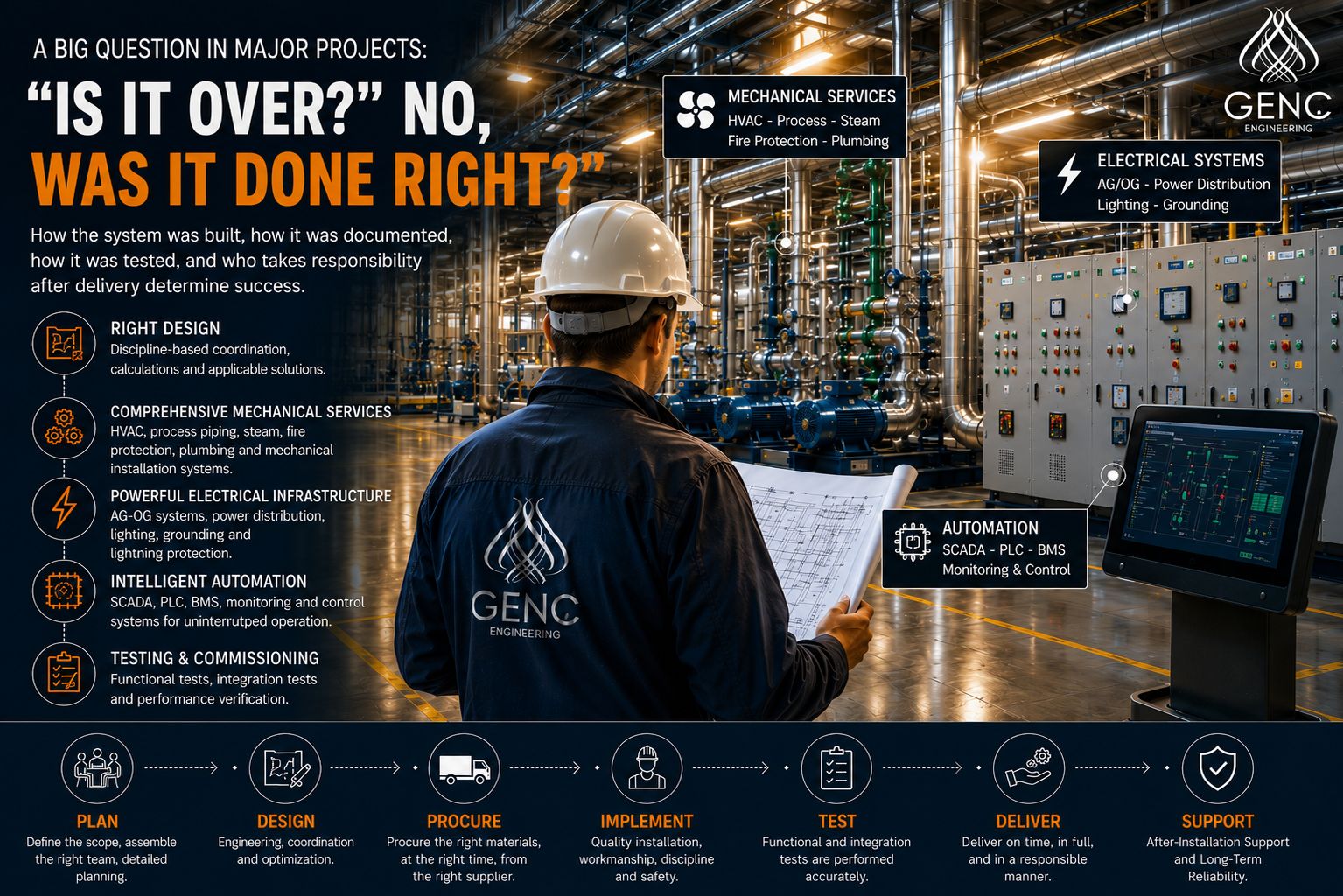
Success in large-scale investment projects is not measured by physical progress alone; it is measured by how the system is established, documented, tested, and by who assumes responsibility after project delivery.
When investors and major construction companies evaluate large-scale projects, they often ask the same question: “When will the project be completed?” Anyone who has spent years in the field knows that this is not the most critical question. A physically completed project and a technically completed project are not necessarily the same thing.
In projects where electromechanical systems form the heart of the structure—such as hospitals, airports, industrial facilities, mixed-use developments, and large infrastructure projects—the real risk does not lie in the percentage of construction progress. The actual risk is hidden in how systems are installed, how disciplines are coordinated, how the supply chain is managed, how commissioning processes are validated, and who takes responsibility after project handover.
Today, money is no longer lost in major projects in Türkiye solely through budget overruns. Losses occur through poorly designed processes, insufficient coordination, weak supply chains, unverified systems, and contractors who disappear after project delivery. The purpose of this article is to reveal these hidden cost layers—often overlooked by investors and major construction companies—from an engineering perspective.
When the System on Site Does Not Match the System on Paper
A project always appears correct within design documentation. Routes are defined, equipment layouts are completed, and sections are prepared. However, once site realities emerge—existing structural tolerances, architectural revisions, equipment dimension variations, mandatory changes from other disciplines, or field decisions made under schedule pressure—the project can gradually become disconnected from reality.
The issue is not the change itself. Changes are inevitable in large projects. The issue lies in whether these changes are managed within technical discipline and properly approved. Otherwise, the project documentation and the actual installed system gradually evolve into two separate realities.
This divergence does not create its cost during construction; rather, it becomes a hidden cost that emerges during operation. Maintenance teams cannot properly interpret the system, troubleshooting becomes prolonged, and future modifications are made based on incorrect information. Even small interventions become risky. The project may appear complete, yet its technical memory remains incomplete.
"As-built documentation is far more than an attachment to progress payment records. It is the technical memory of the project."
Properly maintained as-built documentation does not merely indicate the quantity of work completed on site; it demonstrates the accuracy of the installation, its exact location, the reasons behind revisions, and its relationship with other disciplines. This culture is the only guarantee that an investment will remain traceable years later. In facilities such as hospitals, where a service life of 30 to 40 years is expected, it is not a preference but a necessity.
Coordination Is Resolved in Space, Not on Drawings
Interdisciplinary coordination is one of the most expensive challenges in large-scale projects. In many projects, it is discussed during meetings and assumed to be resolved through clash detection reports. However, site reality is different: coordination is not resolved on paper; it is resolved within physical space.
Mechanical ducts, electrical cable trays, fire protection lines, low-current infrastructure, and maintenance access systems sharing the same suspended ceiling are theoretically separate disciplines, yet on site they often compete for the same 40 centimeters of physical space. Real coordination in such a volume is not achieved through a “no clashes detected” report; it is achieved by ensuring systems are arranged in an executable sequence, within accessible maintenance volumes, and through a practical serviceability approach.
The consequences of delayed coordination are ultimately paid for on site: rework, material waste, disruption of schedules, and future maintenance becoming impossible. A valve forgotten above the suspended ceiling in a hospital operating room block can mean shutting down the entire block five years later. A congested project continuously generates costs.
For this reason, coordination in large-scale projects must begin at the design table, not after the tender process. Coordination that is not achieved during the design phase will ultimately have to be resolved on site at a cost of at least twice the time and expense.
Supply Chain: The Real Financing Mechanism Not Written in the Contract
In large-scale projects, procurement goes far beyond purchasing. Particularly for long lead-time equipment—such as main switchgear systems, generators, chiller units, fire pumps, and specialized air handling units—procurement essentially functions as a mechanism of trust.
Manufacturers evaluate not only what they sell, but also to whom they sell. They assess a contractor’s payment discipline, site organization, technical capabilities, and continuity within the industry. When working with a contractor they trust, manufacturers manage production schedules more carefully, provide stronger technical support, and, when necessary, offer financial flexibility. This is an advantage not written into contracts, yet one that directly influences project flow.
When working with inexperienced contractors or firms that have not established market credibility, the procurement process often works in reverse. Suppliers transfer their risk into pricing, tighten payment conditions, reduce schedule flexibility, and limit technical support. Investors begin experiencing these hidden disadvantages midway through the project—often without having recognized them at the beginning. At that stage, changing the contractor is no longer a realistic option, and the cost is ultimately absorbed by the project itself.
"Equipment not procured at the right time can disrupt project flow for days; incorrectly procured material becomes the most expensive material on site."
This is where the true value of a strong MEP contractor becomes evident. A capable MEP contractor is not merely an executing party; it is a solution partner capable of managing the supply chain, establishing the right relationships with manufacturers, technically evaluating alternatives, and leveraging purchasing power to the benefit of the project.
Project Management Intelligence: The Ability to Anticipate the Process
In large-scale projects, technical knowledge alone is not sufficient. Technical expertise must be transferred correctly to the field, teams must be mobilized in the proper sequence, decisions must be made at the right time, and procurement must progress in harmony with construction activities. At this point, the quality of the project management team becomes a decisive factor.
Project management is not simply tracking schedules, holding weekly meetings, or preparing reports. These are necessary tools, but they do not, by themselves, constitute project management. True project management means identifying problems before they arise rather than reacting to them after they emerge on site. It means being able to foresee which installation activity will affect which discipline, which equipment carries schedule risks, and which delayed decision could potentially halt an entire area of work.
This instinct is not acquired from books; it is gained through field experience. Experience does not simply mean having completed numerous projects. It means having carried out enough projects to avoid repeating the same mistake twice. If organizational structures are weak, teams wait for one another, decisions are delayed, and site productivity declines. If the organization is strong, workflow develops naturally on site. This flow represents one of the largest savings elements that never appears in project reports or cost tables.
“Working” Does Not Mean “Working Correctly”
Commissioning is one of the most misunderstood phases of large-scale projects. If a pump starts rotating, an air handling unit is energized, or equipment becomes visible on the automation interface, commissioning is often assumed to be complete. This is an incomplete definition.
Commissioning is not the process of proving that a system operates; it is the process of proving that a system operates correctly. Hydraulic balancing, airflow measurements, pressure verification, testing automation scenarios, confirming which fans operate under fire conditions and in which modes, and determining which loads are supplied when generators come online—all of these must be tested under operational load conditions and properly documented.
A system may be functioning, but if it operates at incorrect flow rates, improper pressure levels, or under insufficient load scenarios, it cannot be considered technically complete. These deficiencies eventually reveal themselves during operation through increased energy costs, user complaints, more frequent failures, and higher maintenance expenses.
Automation systems may be installed; however, if operational scenarios are not configured according to actual usage requirements, the system becomes nothing more than a monitoring screen. Properly designed automation, on the other hand, manages the system, optimizes performance, and detects failures at an early stage.
Whether operating room pressure cascades in a hospital function correctly, whether an airport smoke extraction scenario actually performs during a fire event, or whether redundant systems in an industrial facility activate at the right moment—all are outcomes of discipline during this phase.
Commissioning is not a formality performed at the end of a project; it is the technical validation stage that determines the true performance of an investment.
The Contractor’s Invisible Responsibility: Representing the Employer Correctly
In many projects, an MEP contractor is perceived simply as the party responsible for execution. In experienced and complex projects, however, this role extends far beyond implementation. A strong MEP contractor serves as the employer’s technical intelligence and voice on site. Throughout processes involving consultants, supervisory authorities, public institutions, and regulatory bodies, the contractor must be capable of representing the employer’s interests through sound technical judgment.
This representation is not merely about attending meetings or answering questions. Preparing the correct application documentation, presenting complete technical records, defending specification compliance, anticipating institutional expectations, and preventing unnecessary revisions are all components of a project management mindset.
A poorly managed approval process, delayed authorization, or incomplete technical documentation directly translates into time and financial losses for the employer. These losses do not appear in project tables as material or labor costs, yet they can affect the overall project duration and budget as significantly as physical construction itself.
"In a project, avoiding losses can be just as important as generating gains."
The Real Responsibility Begins After Handover
In many projects, handover is considered the end of the work. Site reality is different: the initial operation of systems and their long-term stable performance are not the same thing.
Commissioning takes place under controlled conditions; however, real-life operation introduces actual user behaviors, seasonal variations, fluctuating loads, and maintenance practices. In large and complex systems, the defining factor is not whether problems occur, but how those problems are managed when they arise.
This is where the contractor’s real capability becomes evident. A strong contractor quickly diagnoses issues, deploys the right team to the field, communicates directly with manufacturers, manages warranty and service processes, and stabilizes the system in a short period of time. A weak organization distributes responsibility, struggles to communicate with manufacturers, and prolongs the process.
"For an investor, the right question is not: ‘Who will install this system?’ The real question is: ‘Who will take responsibility when this system encounters a problem?’"
Companies that operate only on a project-by-project basis, lack continuity, and fail to maintain a stable technical organization may leave investors alone at the most critical moment—during the first year following commissioning.
Sustainable organizations, on the other hand, do not simply deliver projects; they continue contributing for years by ensuring systems are stabilized, fine-tuned, and capable of operating reliably over the long term.
Engineering Is a Culture, Not a Service
Success in large-scale projects depends on establishing the entire process correctly—from design to site execution, from coordination to procurement, and from commissioning to post-handover support.
Today, the critical decision for investors is not merely selecting a company to perform the work. The real choice is selecting a solution partner capable of understanding the project, building the system correctly, identifying risks early, managing supply chains effectively, representing the employer properly, and assuming responsibility after delivery.
MEP systems are no longer simply installation packages. They are the core systems that determine a building’s energy performance, operational cost, user comfort, safety, and sustainability. Whether a hospital truly functions like a hospital, or an airport truly functions like an airport, depends on the reliability and accuracy of these systems.
Therefore, the right question is no longer: "Has this project been completed?"
The right question is: "Has this project been built correctly, tested correctly, documented correctly, and will it be able to operate sustainably?"
What differentiates large projects is not price, speed, or physical progress. The true differentiator is an engineering culture capable of building systems, managing processes, understanding field realities, controlling supply chains, representing employers correctly, and taking responsibility long after project completion.
At Genç Engineering, this is how we approach large-scale projects. Because what an investor receives at handover is not merely a building it is a system expected to operate reliably for decades. Our responsibility is not only to build that system, but also to stand behind it.